
Why DIY Odor Removal Fails After Trauma or Death—and What 2026 Professionals Do Differently
DIY odor removal fails after trauma or death because decomposition odors are caused by complex VOCs that embed into porous materials, structural cavities, and HVAC systems. Professional 2026 remediation succeeds by combining source removal, material evaluation, controlled air chemistry, airflow management, and post-remediation verification rather than masking smells with consumer products.
Introduction: “We Tried Everything… Why Is It Still There?”
Homeowners dealing with lingering odors after a traumatic event often do exactly what seems logical:
- Deep cleaning
- Replacing furniture
- Running air purifiers
- Using sprays, foggers, or ozone devices
And yet—the odor returns.
This isn’t because the effort was lazy or misguided. It’s because decomposition odor is not a household cleaning problem. It’s a chemical, structural, and airflow problem.
Also Read ☣️The Science of Odor Neutralization After Trauma or Death
The Core Misunderstanding: Odor Is Not Dirt
Dirt Sits on Surfaces. Odor Lives in Systems.
DIY methods are designed for:
- Cooking smells
- Pet odors
- Everyday indoor air issues
Trauma and death odors are fundamentally different because they involve:
- Volatile organic compounds (VOCs)
- Deep absorption into materials
- Ongoing off-gassing
- Redistribution via airflow
You can clean every visible surface and still leave the odor source intact.
The Most Common DIY Odor Removal Methods—and Why They Fail
1. Air Fresheners and Scented Sprays
What they do:
Temporarily overwhelm your sense of smell.
Why they fail:
They do not neutralize VOCs. Once the fragrance fades, the odor returns—sometimes stronger due to sensory contrast.
2. Consumer Air Purifiers
What they do:
Filter particulates and some general odors in circulating air.
Why they fail:
- They don’t address embedded VOCs in materials
- They don’t treat structural cavities
- They can’t overcome active off-gassing
They clean air that’s already contaminated—without stopping the source.
3. Ozone Machines and “Shock Treatments”
What people expect:
Permanent odor destruction.
What actually happens:
- Temporary reduction at best
- Potential material damage
- Health risks if misused
- VOCs driven deeper into porous materials
By 2026 standards, uncontrolled ozone use is considered outdated and risky.
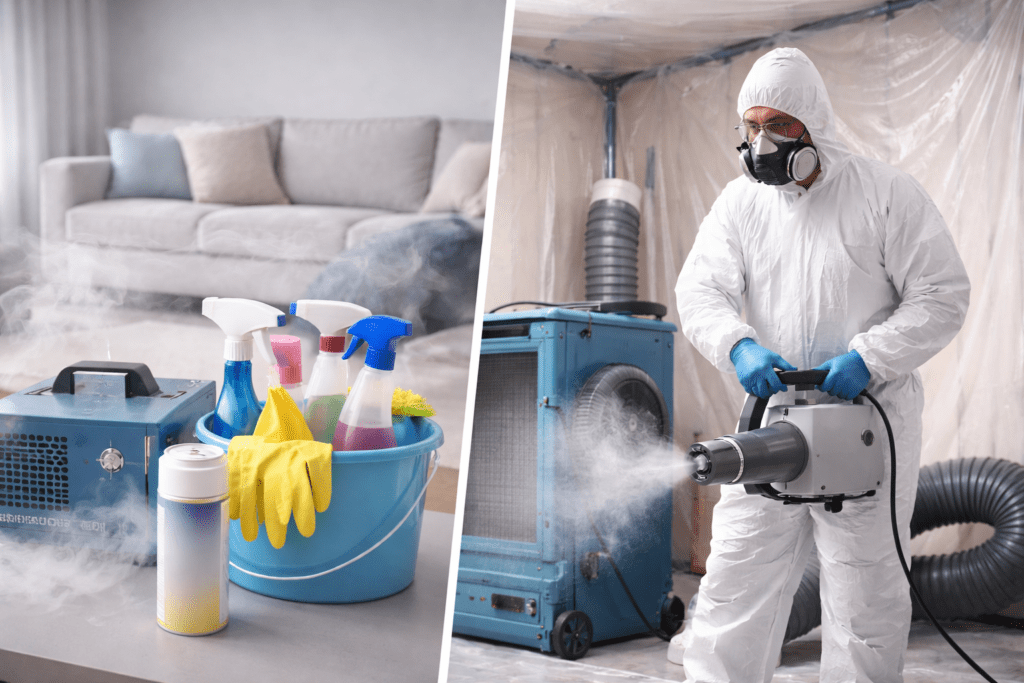
4. DIY Fogging or Deodorizing Bombs
What they do:
Disperse chemicals indiscriminately into a space.
Why they fail:
- They don’t penetrate all odor reservoirs evenly
- They leave residue
- They often miss hidden cavities
- They provide no verification
Fogging without source removal is cosmetic—not corrective.
Also Read ☣️Why Biohazard Remediation Isn’t Cleaning | Sanitation vs Decontamination
The Big Problem DIY Can’t Solve: Hidden Odor Reservoirs
DIY approaches fail because they can’t reliably access or evaluate:
- Subflooring and joists
- Drywall backing and insulation
- Wall and ceiling cavities
- HVAC ductwork and coils
- Furniture framing and padding
These areas silently store and release odor compounds long after cleaning.
What 2026 Professionals Do Differently (And Why It Works)
1. Source Removal Comes First—Always
Professionals remove:
- Biological material
- Contaminated porous contents
- Impacted structural materials when necessary
No air treatment works if the source remains.
2. Material Science Guides Decisions
Instead of guessing, professionals assess:
- Absorption depth
- Material porosity
- Time-based off-gassing behavior
This prevents the mistake of “saving” materials that will continue to smell.
3. Controlled Air Chemistry (Not Guesswork)
2026 remediation uses:
- Hydroxyl radical generation for continuous neutralization
- Vapor-phase deodorization for deep penetration
- Oxidation strategies matched to material tolerance
These methods break odor molecules apart rather than hiding them.
4. Airflow and HVAC Are Treated as Odor Pathways
Professionals manage:
- Negative air containment
- Pressure differentials
- HVAC isolation and evaluation
DIY methods almost always ignore airflow—which is how odors travel.
5. Verification Replaces Guessing
Professionals confirm results through:
- Extended dwell periods
- HVAC cycling checks
- Targeted inspections
- Documentation and follow-up
DIY ends when the smell seems “better.”
Professional remediation ends when it’s stable.
Also Read ☣️What Is the Full Life-Cycle of a Professional Biohazard Cleanup?
Why DIY Often Makes Professional Remediation Harder Later
Unfortunately, some DIY attempts:
- Push VOCs deeper into materials
- Spread contamination further
- Mask true odor sources
- Delay proper intervention
This can increase scope, cost, and time once professionals are finally called.
Absolute Bioremediation’s 2026-Ready Perspective
Absolute Bioremediation approaches odor elimination as a systems problem, integrating:
- Biology
- Chemistry
- Building science
- Airflow engineering
- Verification-based outcomes
The goal isn’t short-term relief—it’s permanent resolution.
Conclusion: DIY Isn’t Wrong—It’s Just Not Built for This Problem
Trauma and death odors persist not because people didn’t try hard enough, but because:
- The problem is invisible
- The chemistry is complex
- The building itself becomes involved
By 2026 standards, professional remediation succeeds because it respects how odor actually behaves—not how we wish it would.
FAQs
1. Why doesn’t DIY odor removal work after a death?
Because VOCs embed into materials and continue off-gassing beyond surface cleaning.
2. Can air purifiers permanently remove decomposition odors?
No. They don’t address embedded or structural odor sources.
3. Is ozone safe for odor removal?
Uncontrolled ozone use carries risks and is not a preferred 2026 practice.
4. Why does odor come back after cleaning?
Hidden materials and airflow pathways were not addressed.
5. Can furniture hold decomposition odors?
Yes. Padding and framing can absorb VOCs deeply.
6. Does fogging remove odor permanently?
Not without source removal and verification.
7. How do professionals stop odor recurrence?
By combining source removal, air treatment, airflow control, and verification.
8. Is demolition always required?
Not always, but sometimes it’s the most reliable solution.
9. Why does HVAC matter for odor removal?
It can redistribute odors throughout a building.
10. When should professionals be called?
As soon as odor persists beyond basic cleaning or returns after DIY efforts.