
Authority & Context
This article is written for New York State property owners, landlords, insurers, attorneys, municipalities, healthcare administrators, and facility managers who require medically defensible, regulator-aligned biohazard remediation. It reflects current OSHA, EPA, CDC, and New York State guidance and describes professional biohazard remediation standards—not consumer or janitorial cleaning practices.
Biohazard remediation exists at the intersection of public health, environmental regulation, and legal liability. In New York, improper handling of biological contamination can trigger insurance denials, code violations, tenant disputes, and long-term health exposure claims. This article outlines the professional framework designed to prevent those outcomes.
Biohazard Cleanup as a Regulated Risk-Management Process
Professional biohazard cleanup is a closed-loop risk-management system. Biological contamination spreads invisibly, persists within porous materials, and creates predictable health and legal consequences when mishandled. Each phase of the cleanup life-cycle exists to control a specific risk. Skipping any phase reliably produces downstream failure.
Unlike cosmetic cleaning, biohazard remediation is governed by overlapping standards: OSHA bloodborne pathogen rules, EPA waste handling requirements, CDC infection control guidance, and New York State environmental and labor regulations. The life-cycle approach ensures no single risk—biological, structural, or legal—is left unmanaged.
Initial Call and Information Triage
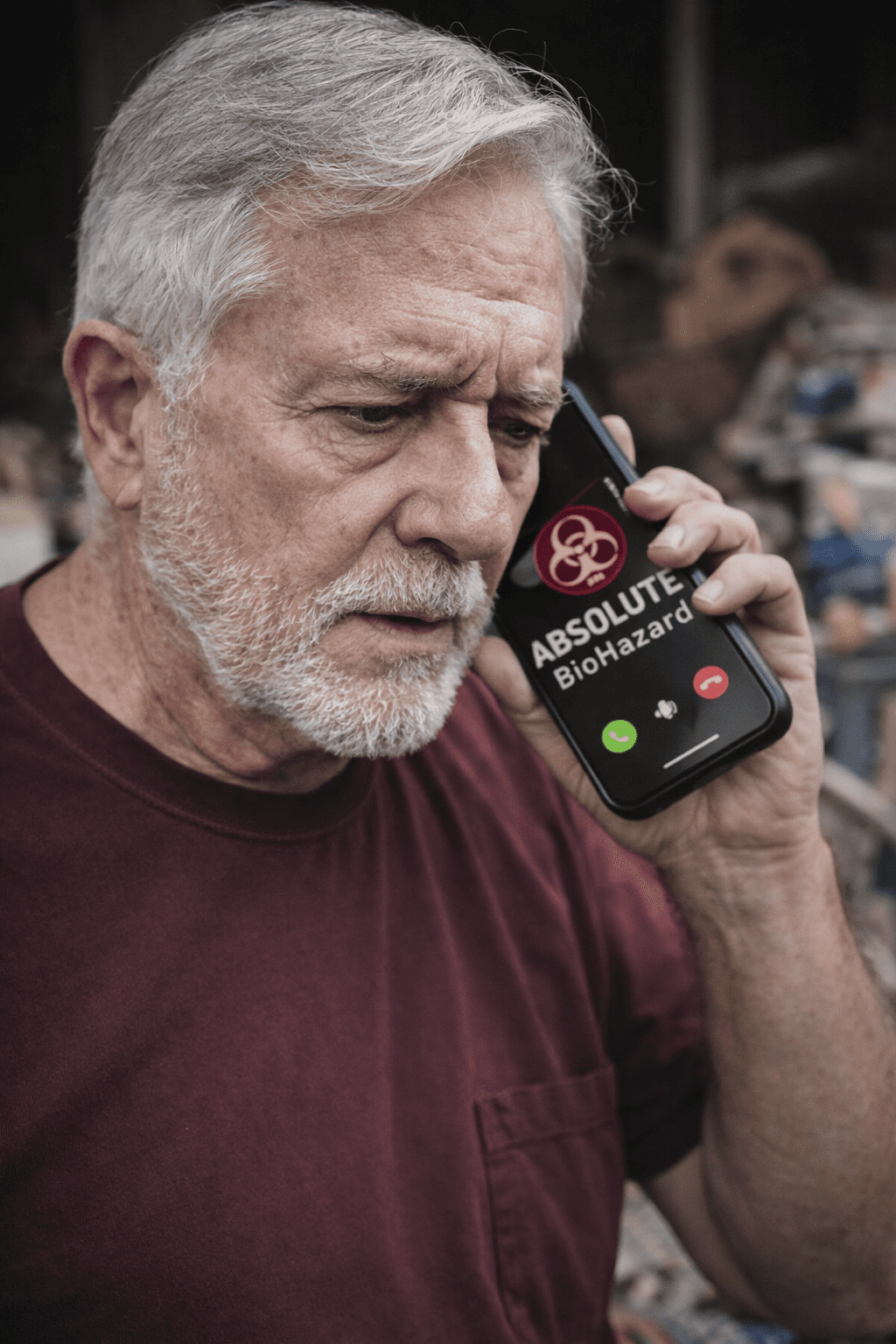
The initial call establishes hazard classification, safety controls, and legal handling before site entry.
The life-cycle begins with the first call. Trained responders collect critical information including incident type, time since exposure, presence of blood or bodily fluids, decomposition indicators, odors, insect or rodent activity, structural damage, and whether cleanup was attempted.
In New York, this information also determines whether additional reporting obligations exist and what waste streams may be involved. Improper classification at this stage can result in technicians arriving under-protected or with insufficient containment equipment, increasing exposure risk and liability from the outset.
Site Assessment and Hazard Mapping
On-site assessment identifies visible and hidden contamination pathways that must be addressed to prevent re-exposure.
Upon arrival, technicians perform a structured assessment that includes visual inspection, moisture detection, evaluation of porous materials, airflow analysis, and identification of secondary contamination pathways such as HVAC systems, wall cavities, subflooring, and drainage routes.
In New York’s older housing stock—brownstones, pre-war apartments, multi-unit residences—contamination often migrates beyond visible areas. Shared ventilation systems and aging materials allow biological matter to travel unpredictably, making hazard mapping essential for complete remediation and legal defensibility.
Also Read 👉🏼Hoarding Cleanup FAQs | Expert Answers from New York’s Leading Biohazard Remediation Specialists
Containment and Engineering Controls
Containment prevents airborne pathogens from spreading during remediation activities.
Before removal begins, containment systems are installed. These may include physical barriers, sealed doorways, negative air pressure, and HEPA air filtration.
This phase aligns with infection-control principles used in hospitals and laboratories. Without containment, cleanup activities can aerosolize pathogens, spreading contamination into unaffected areas, neighboring apartments, or shared building systems—an especially serious risk in New York’s dense residential environments.
Gross Removal of Contaminated Materials

Porous materials saturated with biological matter must be removed rather than cleaned.
Materials such as carpeting, padding, drywall, furniture, mattresses, and personal belongings that cannot be reliably disinfected are removed. Porous materials absorb biological matter at a cellular level and cannot be safely restored.
In New York, improper disposal of biohazardous materials can result in regulatory penalties and civil liability. All materials are packaged, labeled, transported, and disposed of through licensed medical waste channels in compliance with state and federal law.
Also Read 👉🏼Levels of Hoarding: Understanding Risk, Biohazard Severity & Professional Remediation Strategies in New York
Detailed Cleaning and Biological Deactivation
Microscopic pathogens are neutralized using medical-grade disinfectants with verified dwell times.
After gross removal, remaining surfaces are cleaned and disinfected. Enzyme cleaners break down organic matter, while EPA-registered disinfectants neutralize bacteria, viruses, and other pathogens.
Strict dwell times are required to achieve documented kill rates. Rushed or improper application—common in non-professional cleanup—leaves viable pathogens behind and creates false confidence in surface cleanliness.
Odor Neutralization and Air Quality Control
Odors are eliminated at the molecular level, not masked.
Biological events release volatile organic compounds that persist long after visible cleanup. Masking agents and fragrances do not solve the problem and often indicate incomplete remediation.
Professional remediation uses hydroxyl generation, controlled ozone application when appropriate, and advanced filtration to neutralize odor-causing compounds. Air quality monitoring ensures these methods resolve odors without introducing secondary respiratory risks.
Also Read 👉🏼Odor Removal and Remediation After an Unattended Death
Structural Decontamination and Restoration Preparation

Hidden contamination is sealed or removed to prevent future exposure.
This phase may include subfloor treatment, encapsulation of affected framing, HVAC cleaning, and antimicrobial coatings in high-risk zones.
In New York properties, this step is critical for landlord compliance, insurance acceptance, and future occupancy. Failure to address hidden contamination can result in recurring odors, tenant complaints, and post-remediation liability claims.
Final Clearance Testing and Verification
Objective testing confirms the environment is safe for human occupancy.
Professional remediation is incomplete without verification. Clearance may include ATP testing, surface sampling, air sampling, or third-party industrial hygiene clearance.
Clearance documentation protects property owners, landlords, insurers, and future occupants by providing objective proof that remediation met professional standards.
New York State Service Context
New York’s density, building stock, and regulations increase remediation complexity.
Absolute BioHazard Remediation serves New York City, Long Island, Westchester County, the Hudson Valley, and surrounding regions. Older construction, shared ventilation systems, and strict regulatory oversight make professional remediation essential throughout the state.
All work aligns with OSHA, EPA, CDC, and applicable New York State regulations, ensuring both health safety and legal compliance.
Conclusion: Why the Full Life-Cycle Matters
The full life-cycle protects health, property, and liability—and only licensed New York professionals can execute it correctly.
Biohazard cleanup is not cosmetic cleaning; it is regulated risk management. Skipping steps or relying on visual cleanliness leaves behind invisible hazards with long-term health, legal, and financial consequences. That is why professional credentials, licensing, and documented processes matter as much as the cleanup itself.
Absolute BioHazard Remediation operates within the full, regulated life-cycle outlined above and holds the appropriate licenses and authorizations required to perform biohazard remediation work throughout New York State. Their technicians are trained to comply with OSHA bloodborne pathogen standards, EPA waste-handling requirements, CDC infection-control guidance, and applicable New York State and local regulations governing environmental safety and labor practices.
This professional foundation ensures that every job—from a single-family home to a multi-unit residential building or commercial property—is handled with medically defensible procedures, lawful waste disposal, and verifiable clearance testing. Property owners, landlords, insurers, and municipalities can rely on the documentation, chain-of-custody records, and objective verification that follow each completed project.
As New York State’s leading biohazard remediation providers, Absolute BioHazard Remediation is trusted because they do not cut corners, rush processes, or rely on cosmetic results. They follow the full life-cycle every time—protecting occupants, preserving property value, and reducing liability exposure.
When a biohazard situation occurs, choosing a licensed, experienced, New York–based professional is not optional. It is the difference between temporary cleanup and responsible remediation. Absolute BioHazard Remediation exists to ensure that difference is done right.
FAQ: Biohazard Cleanup in New York

1. How long does a full biohazard cleanup take in New York?
Most professional biohazard cleanups take one to five days, depending on contamination extent, building type, and clearance requirements.
2. Why is professional biohazard cleanup important in NYC apartments?
Shared walls, ventilation systems, and older building materials increase the risk of hidden contamination spreading beyond visible areas.
3. Is clearance testing required in New York State?
While not always legally mandated, clearance testing is considered best practice and is often required by insurers, landlords, or property managers.
4. Can biohazard odors return after cleanup?
Odors do not return when remediation includes molecular odor neutralization and proper clearance verification.
5. How is biohazard waste disposed of in New York?
Contaminated materials are packaged, labeled, transported, and disposed of through licensed medical waste facilities in compliance with New York regulations.
6. Should occupants stay in the property during cleanup?
No. Properties should remain unoccupied until clearance testing confirms the environment is safe.
7. Are biohazard cleanups covered by insurance in New York?
Many trauma and unattended death cleanups are covered by insurance, provided professional remediation and documentation are used.
8. How do technicians comply with New York safety laws?
Through OSHA-compliant training, proper PPE, engineered containment systems, and regulated waste handling procedures.
9. What makes biohazard cleanup more complex in New York State?
High population density, shared infrastructure, older buildings, and strict regulatory oversight increase remediation complexity.
10. How can I verify that a cleanup was done correctly?
Request documentation, waste manifests, and clearance results from a certified biohazard remediation provider.